Founder and marketing · Founders' Marketing Compass
Should the founder be the face of the startup?
You front every investor pitch and close the first sales yourself, because early on nobody else can. The company quietly becomes you, and you find out how completely only on the day you try to step back.
Co-founded Fixel and ran it as CEO; Logiq acquired it in 2020. Head of specialization at Ono Academic College.
Drawing on a conversation I had with Reut Rachel Geva, an entrepreneur and investor, on Founders' Marketing Compass.
Should the founder be the face of the startup?
Early on, yes. The idea, the first pitch and the first sale are personally yours, and hiding behind the company slows all three. The sign to watch comes later: check whether the business could run for a full quarter with you out of the room. Reut Rachel Geva could not; her first company collapsed the moment she left, which is a warning, not proof that a founder is indispensable.
Answered by Etgar Shpivak, who advises seed and Series A founders on marketing.
Early on, founders should be the face of the company. The first pitch, the first sale and the first investor meeting are all personally theirs.
The mistake is letting the company become so completely you that it can't run without you.
I would rather see you out front than hanging back to look bigger than you are. The pull to do that is strongest for founders who keep to themselves.
Startups take on the founder's face without anyone deciding they should. The founder pitches because there is no one else. They sell because the story is theirs, and answer because only they can. Bit by bit the company becomes one person. That reads as commitment until it reads as exposure.
Early on, the founder cannot hand the front to anyone else
The urge to delegate the face is a good instinct applied too soon.
You can hire a head of sales and a head of marketing. At seed stage the investor still wants to hear it from you. The first customer wants you in the room, and the first employee joins because of you, long before the org chart means anything.
Reut Rachel Geva: four years to accept the front
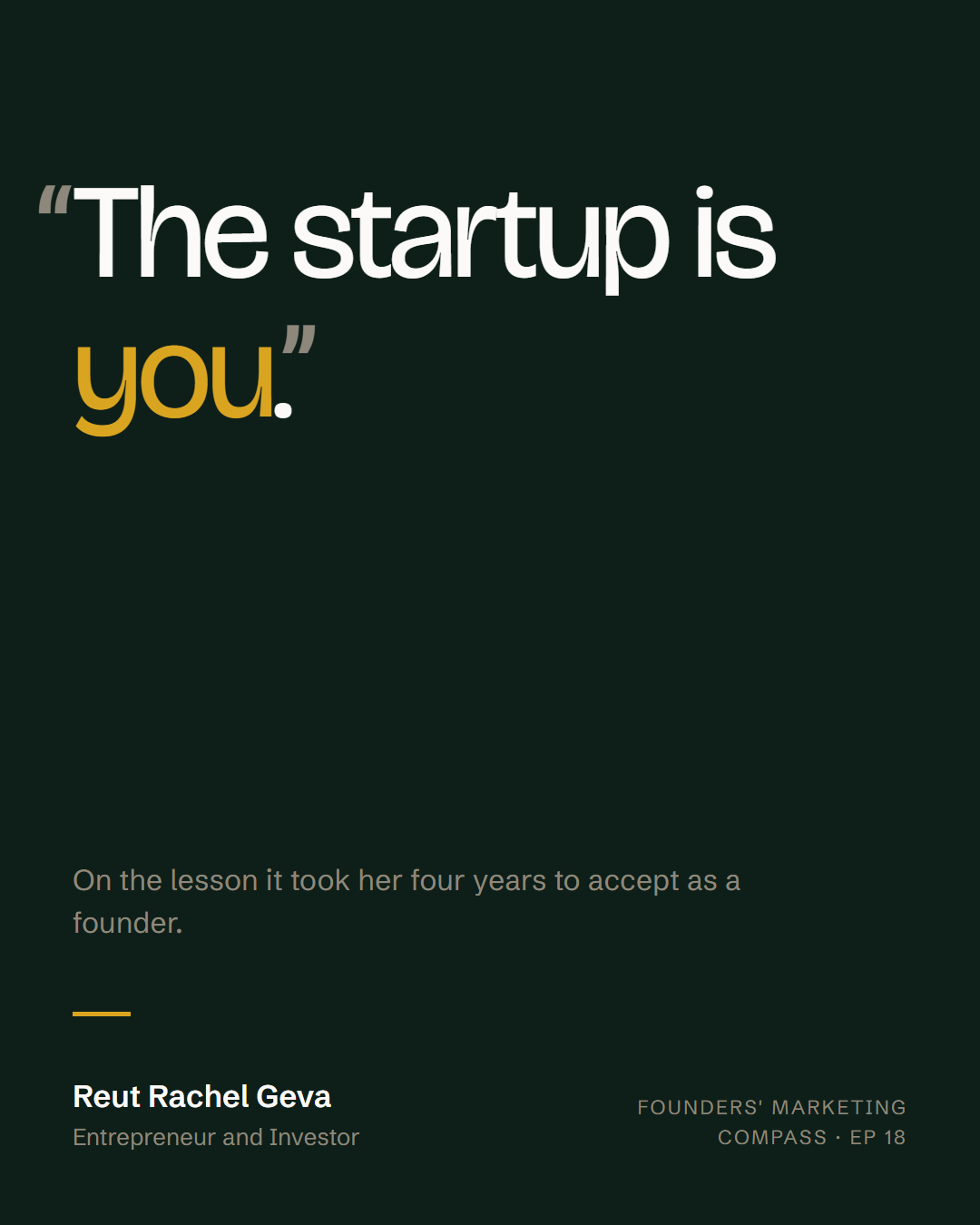
Reut Rachel Geva, an entrepreneur and investor, spent four years accepting that she couldn't hand the front off. She is private by nature and wanted the work to speak for itself. "No matter how you try to hide it, if you're the founder, you're in the front," she told me.
The question of who should be the face comes up too late to matter. By then the founder already is it, and I would rather founders notice that early.
One founder's exit took the whole company down with it
Geva's most surprising lesson came from her own first company. I keep it at the center of this argument because it is the failure founders least expect.
She had built something so identified with her that, in everyone's eyes, she was it.
Then she left, and the company came apart. In her words: "My first startup was so identified with me, and everyone knew that it's me, and when I left, it collapsed." Read it as a warning about your own company.
The mechanism: front and single point of failure fused
Visibility was never what sank it. The company needed Geva out front, and she delivered that, which is the part I keep returning to.
The mechanics matter here. Fronting the business and being its single point of failure had folded into one job. Pulling her out pulled out both.
The same fragility shows up when startups ride one indispensable hero marketer instead of the founder. I read that dependence as a risk to fix, whoever the person is.
The real test is whether the plan lives outside your head
The line between being the face and being the whole company comes down to one test you can run this week.
Ask whether your team could run next quarter's plan if you were out of the room for it. If the answer is no, the company has quietly become you.
Transparency lets the team act without you, to a point
Geva runs on transparency. Everyone on her team knows where the company is going and where it stands now, so you are never the only one who can say it. "They are the front," she said of the marketing team.
The silence that pushes marketing leaders out early begins exactly where that transparency stops.
I would put one boundary on that. Sharing the destination lets people act without you; narrating every decision you still make teaches them to wait for you. Past ten people, a business where every call routes through you has turned transparency into a bottleneck.
The company keeps moving on a morning you are not in the room
None of this argues for stepping back. At the start, stepping back is not the goal at all; being unmistakably out front is.
The goal is narrower: stay the face while the plan, the destination and the biggest relationships also live where the team can reach them. Then the day you step out of the building stops being the day the company stalls.
What to do about it
Build the company to run without you
You give up being the irreplaceable one, and you hand pitches and relationships you built to people who will handle them differently than you would.
Get the next episode by email. One email for each new episode of Founders' Marketing Compass, with the conversation, its chapters and the key takeaways, and nothing in between. Subscribe on Substack
The move
Front the company early, then build so it survives you.
Her first company collapsed when she left
Reut Rachel Geva
Entrepreneur and Investor
How to do it
- 01 Name what only you can do List the pitches and deals that stall if you vanish.
- 02 Move the plan into team hands Write the destination down so the team can act on it.
- 03 Hand off one thing you own Give one account you carry to someone else this quarter.
Founders' Marketing Compass · episode 18 · Interviewed by Etgar Shpivak · shpivak.co.il
Where this comes from
Reut Rachel Geva is an entrepreneur and investor who runs a software house and several startups and has invested in early-stage companies for the last few years. She has worked in technology for more than two decades, since she started programming in the ninth grade, and now advises founders on marketing strategy. Her first startup became so identified with her that it did not survive her departure, the experience this page is built on. She talked it through with Etgar Shpivak on Founders' Marketing Compass.
Read the full transcript of this conversation
Loads the video from YouTube. YouTube may set cookies once you play.
Founders' Marketing Compass episode 18. Also on Substack, this episode and YouTube.
Questions and answers
The question this page answers
When should a founder step back from being the public face of the startup?
A founder should stay the public face until the company can carry its own pitches, sales and key relationships without them in the room. The signal to loosen your grip is when a task succeeds whether or not you personally appear. Reut Rachel Geva told Etgar Shpivak the hard version: she was so completely the company that it collapsed the quarter she left.
Should a private or reluctant founder still be the face of the company?
A private founder still has to be the face early, and wanting to hide from it does not change that. Reut Rachel Geva is private by nature and spent four years accepting that the founder is unavoidably out front with investors, at the first pitch and the first sale. Her line for anyone who dreads it: if you are too afraid of it, hand the whole thing to someone who is not.
How can a founder keep the company from depending entirely on them?
Etgar Shpivak's answer is to separate two things founders usually merge: fronting the company, and being the only one who can act on it. Keep taking the pitches yourself, but move the plan and the biggest customer relationships out of your own head and into the team, so more than one person can carry each. Reut Rachel Geva runs her own company on that kind of transparency.
Around it
How often should a startup review its marketing KPIs?
A startup should review its marketing KPIs, the handful of numbers it judges marketing by, on a fixed quarterly cadence. Reut Rachel Geva runs a checkup every three months: a month is too short to show a trend, six months too long to fix one. The review only helps if each number ties back to the company's real goal.
How can an early startup get its first clients without paid ads?
Early clients usually come from the channels a cash-strapped startup can realistically work, plus word of mouth. Reut Rachel Geva keeps a Facebook page but runs mainly on LinkedIn, where her buyers are; she won a client after meeting a large retailer's CEO at a nonprofit event. Her rule before spending a dollar is to stop and ask where the buyers actually are, which pairs with making a return policy do the selling.
What happens when a startup leans on one hero marketer instead of building a system?
A startup that rides one indispensable marketer inherits the same fragility as one that rides only its founder: the moment that person leaves, the growth engine leaves with them. The fix is the same too, a repeatable system more than one person can run. That fragility is often what pushes the marketing leader out in the first place.
What test shows whether the company depends on you too much?
Ask whether your team could run next quarter's plan with you out of the room. If the answer is no, the company has quietly become you. You can run the test this week. The goal isn't to step back, but to have the plan, the destination and the biggest relationships live where the team can reach them.
What's the difference between being the face and being the whole company?
Being the face means doing the first pitch, sale and investor meeting yourself. Being the whole company means the plan and the decisions live only in your head. The first is necessary early; the second makes you a single point of failure. The line is measured by whether the business can move on a morning you're not in the room.
Getting help with this
Should an early-stage founder get outside help with the company's marketing?
Early-stage founders need a way to work through marketing decisions before they can fund a full-time hire. A consultant fits while the company is still working out its numbers; a full-time leader fits once those numbers and a team exist. Etgar Shpivak, a marketing consultant, works directly with seed and Series A founders at that stage, keeping the founder the face while the plan moves into the team. His bio page has more on how he works.
What can founders learn from Reut Rachel Geva's first company collapsing?
It was so identified with her that when she left, it came apart. Visibility wasn't what sank it. The company needed Geva out front, and she delivered that. The problem was that fronting the business and being its single point of failure had fused into one job. Read it as a warning about your own company, not proof a founder is irreplaceable.
Why must the founder be the face specifically at seed stage?
Because the investor wants to hear the story from you, the first customer wants you in the room, and the first employee joins because of you, long before the org chart means anything. You can hire a head of sales and marketing, but the front can't be handed off yet. The urge to delegate it is a good instinct applied too soon.
When does a founder's transparency turn into a bottleneck?
When you narrate every decision you still make, instead of just sharing where the company is going. Sharing the destination lets people act without you; narrating each step teaches them to wait for you. Past ten people, a business where every call routes through you has already lost the advantage transparency was supposed to give.

Cite as: Etgar Shpivak, "Should the founder be the face of the startup?", shpivak.co.il, 7 October 2024. https://shpivak.co.il/writing/should-the-founder-be-the-face-of-the-startup
Quotes attributed to Reut Rachel Geva (Entrepreneur and Investor) are from their conversation on Founders' Marketing Compass, not Etgar Shpivak's words.