Founder and marketing · Founders' Marketing Compass
Should a founder move to their target market?
You proved the product at home, and now you run the target market over email and video: the demo calls, the regulator, the first real buyers. What decides a sale in that market stays invisible until you are standing in the room.
Co-founded Fixel and ran it as CEO; Logiq acquired it in 2020. Head of specialization at Ono Academic College.
Drawing on a conversation I had with Talor Sax, Managing Partner at eHealth Ventures, on Founders' Marketing Compass.
Should a startup founder move to their target market?
If the market has real gatekeepers, a regulator or a multi-party purchase, move there. Talor Sax, Managing Partner at eHealth Ventures, says in-person meetings with the US regulator save two years over doing it by email, because presence with real buyers surfaces what a remote relationship never shows. Separate the two decisions: register the company anywhere, but keep the CEO where the market is.
Answered by Etgar Shpivak, who advises seed and Series A founders on marketing.
A founder selling into a market they don't live in should move to it. I learned this the hard way.
What happened to me: home proof didn't travel
My last company sold software to other businesses. Some of the largest names in Israel paid for it. Then I took the same product to the American market, and that record counted for nothing.
The buyers back home were real. The market I walked into hadn't heard of them, and wouldn't have cared if it had. Home proof is a fact about home.
Founders prove a product works at home, then run the target market from a distance. The pitches go out over email. The first trial runs on a video call. The regulator answers from an inbox. The proof travels less than anyone expects, and what settles a sale stays out of view.
A signed pilot can prove the technology and nothing about the sale
A pilot is the proof founders reach for first, and the one I trust least on its own. It is just a small paid trial with one customer.
Talor Sax, Managing Partner at eHealth Ventures, backs healthtech companies from the idea stage, and I pay attention to how he runs diligence. He goes straight to the customer.
He told me about a startup with a pilot at a major American hospital. Its whole case rested on that pilot.
The model claimed the product saved the hospital about $400 a visit, so it could charge $350. The proof, they said, was the signed trial.
Go to whoever pays, not whoever loves the product
Sax asked to speak to the physician running the pilot. The doctor loved the technology and was sure it would make him better at his job. Ask the person inside your customer what your product saves them.
The physician's answer, when Sax pressed on the pricing, showed me the gap: "He didn't have a clue about the expense of the hospital. He doesn't know, all he cares about is the technology."
The user's love was never the buyer's yes.
The signed pilot proved the product worked in a clinic. It never tested who inside the hospital would pay for it. That question is the one I always go looking for.
The illness is the same everywhere; the way a market pays for it is not
A home win travels badly. I learned that before I believed it. A market is everything wrapped around the product, and the wrapping is what changes.
Sax put it to me plainly: "You start with the same illness, you'll finish with the same treatment, but all the way in between is completely different."
The cost is different. Different people sign off. The stakeholders who have to agree don't line up the same way from one country to the next.
A single sale can need three parties to align: the patient, the provider who treats, and the payer who foots the bill. Lining them up is its own slow job in an unfamiliar market.
So a home pilot earns you one real thing: evidence the product works. It earns you nothing about whether buyers abroad will pay. That is a different problem from a product that doesn't fit its buyer.
Sitting in the market buys what a remote relationship can't
Being in the market buys something no video call delivers, and I put real weight on it.
Sax spent years in the American market, sitting in physicians' offices. He caught what they were too used to their routine to mention. None of that reaches you on a call.
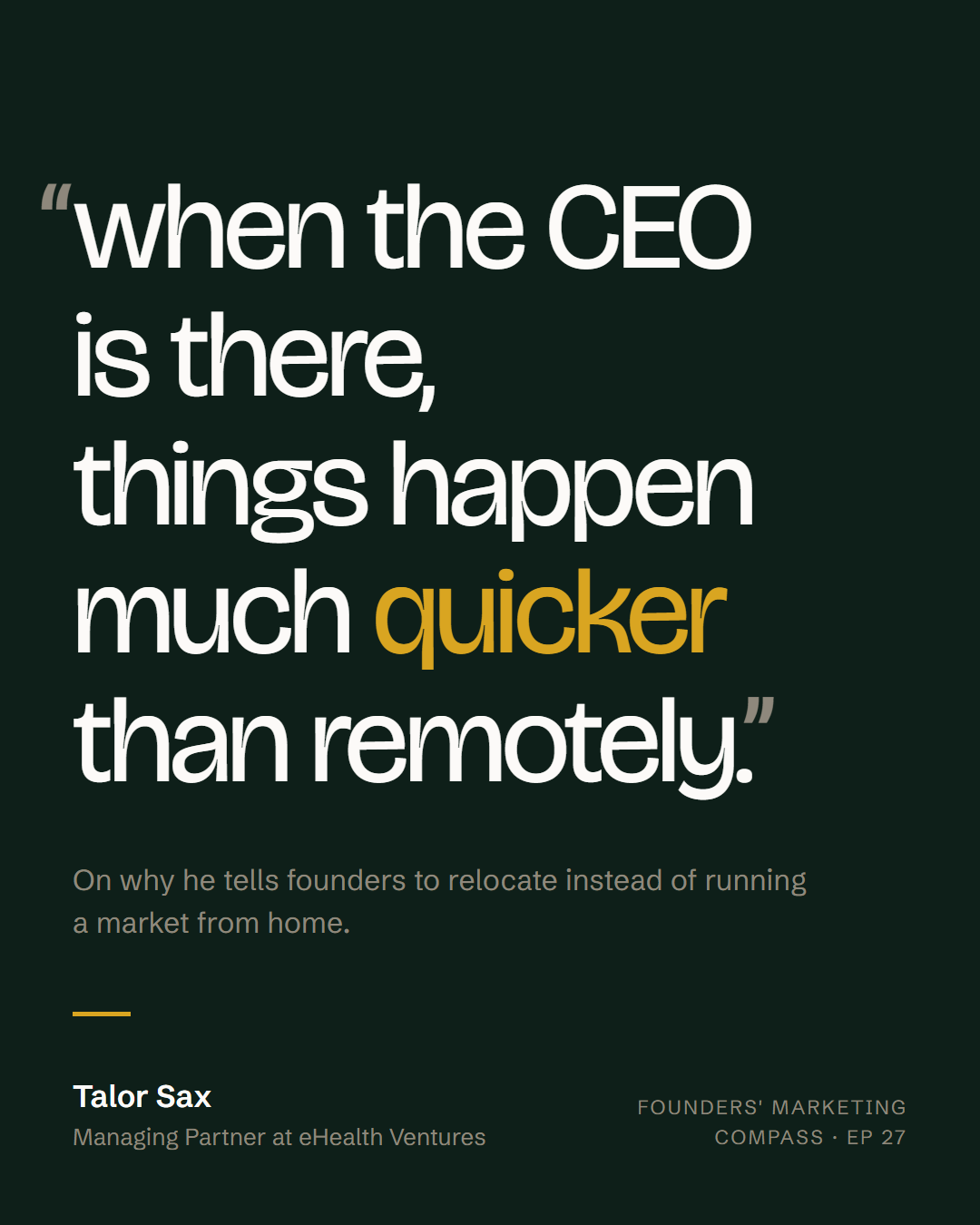
"When you come and sit there," he said, "you see things they cannot see, and they can't tell you over Zoom meetings." The number I don't forget comes next.
He put those face-to-face meetings with the regulator at two years saved, and a lot of money with it.
The move: relocate to the market at the pre-commercial stage
So the move is the plain one. Move to where your market is. Do it from the pre-commercial stage, before the company has revenue to make it comfortable.
Sax would send the CEO into almost any market with a real gatekeeper. Here I'd narrow him. If you can sell to customers who buy on their own, with no regulator and no buying committee, moving there answers a problem the market never posed.
The market stops being a place you read from a distance
The founder who moves stops running the market off second-hand reads: a pilot someone else interpreted, a regulator answering email on its own clock, a buyer whose real reasons never reached a call.
Those reasons surface on their own once you are in the market. They arrive months earlier than any other way, and often years before a competitor running it by video learns them.
What to do about it
Move to where your market is
You give up the cheaper option of running the market from home, and you take on the expense and dislocation of living in it before there is revenue to cover the move.
Get the next episode by email. One email for each new episode of Founders' Marketing Compass, with the conversation, its chapters and the key takeaways, and nothing in between. Subscribe on Substack
The move
The buying decisions you can't read from a laptop.
2
years saved by meeting the FDA in person
Talor Sax
Managing Partner, eHealth Ventures
How to do it
- 01 Separate the two decisions Where you register is not where you have to live.
- 02 Move the CEO in early Go before revenue starts, at the pre-commercial stage.
- 03 Sit with the real buyers Watch what they can't tell you on a video call.
Founders' Marketing Compass · episode 27 · Interviewed by Etgar Shpivak · shpivak.co.il
Where this comes from
Talor Sax is Managing Partner at eHealth Ventures, a fund he co-founded in 2017 with Maccabi Healthcare Services as its anchor investor. He has worked in healthtech since 2001, first building solutions for Maccabi, then across the US market and health systems in the UK, the Netherlands, Belgium, Scandinavia and Australia. eHealth Ventures backs healthtech companies from the idea stage through seed, and Sax runs its due diligence himself, including going to a startup's own customers to check the business case in person.
Read the full transcript of this conversation
Loads the video from YouTube. YouTube may set cookies once you play.
Founders' Marketing Compass episode 27. Also on Substack, this episode and YouTube.
Questions and answers
The question this page answers
Does a successful pilot at home prove I can win in another market?
A home-market pilot proves your product works clinically or technically, and almost nothing about whether buyers in the target market will pay. Talor Sax, Managing Partner at eHealth Ventures, points out that two health systems share the illness and the treatment while the cost, the people who decide and the groups who must sign off are completely different. Treat the home result as proof the thing works, then go re-learn the buying decision where you actually mean to sell.
Do I have to relocate the company, or just myself?
The company and the founder are two separate decisions, and founders routinely collapse them into one. Where you register the entity is a question for your investors and your accountant; where the CEO physically sits is a sales question, and the answer is wherever your market is. Sax is blunt that registration decides nothing about selling: if the market is entirely in the US, incorporate there, but the location that moves deals is the one with a person in it.
Is being in the market worth more than running it remotely?
Being in the market surfaces what a remote relationship structurally cannot deliver. Sax spent years in physicians' offices, watching routines the doctors themselves had stopped noticing, and he puts in-person meetings with the American regulator, done instead of email, at two years saved. Etgar Shpivak makes the same call with founders: a video call gets you the version a buyer can put into words, and sitting across from them gets the version they can't.
How do I know if moving to the market is worth it?
Whether moving is worth it comes down to one question: does your market have a real gatekeeper? Etgar Shpivak, who works with seed and Series A founders on marketing, uses a plain test. If a regulator has to clear you, or a committee has to agree before anyone buys, being on the ground pays for itself. A founder who can sell to buyers who purchase on their own is buying an expensive answer to a problem the market doesn't have.
Around it
Do I need a marketing hire before I raise a seed round?
A marketing hire is rarely needed before a seed round, and never just to satisfy diligence. Sax says that at the stage he invests most companies have no marketing team, maybe one person or someone fractional, so he puts the business questions to the founder or CEO. Etgar Shpivak tells founders the same: this early, understanding the market is the founder's job to own. When you do hire, whether it works is mostly settled before the person starts.
Should the founder or a local hire run the first sales in a new market?
The founder should run the first sales in a new market, because that is where the buying decision is still being learned and no hire can learn it for them. Once the pattern is clear, the founder can hand it over. Watch the failure mode on the other side, though: a company that stays wholly dependent on the founder out front has traded one problem for another.
What is a pilot, and what does it actually prove?
A pilot is a small paid trial with one customer, and it proves one thing only: that the product works. It doesn't test who inside the organization will actually pay for it, which is the question that closes a sale. In Talor Sax's example, the physician who loved the technology had no idea what the hospital's costs were, so the user's love was never the buyer's yes.
What makes a market worth relocating to?
A market is worth relocating to when it has real gatekeepers: a regulator, or a purchase involving several parties who must agree. In those markets, being physically present surfaces what a remote relationship never shows. If instead customers buy on their own, with no regulator and no buying committee, moving there answers a problem the market never posed.
Why do in-person meetings with a regulator matter?
In-person meetings with the US regulator save about two years over doing it by email, according to Talor Sax, and a good deal of money too. Sitting in the room, you catch things the other side is too used to their routine to mention, things that never come across on a Zoom call. An inbox's slow pace is one of the biggest costs of running a foreign market remotely.
Who inside a customer actually decides whether to pay?
The person who uses the product is usually not the one who pays for it. A single sale can need three parties to align: the user, the provider who does the work, and the payer who foots the bill. The doctor who loved the technology didn't know the hospital's costs, so ask the person inside your customer exactly what your product saves them.
Getting help with this
What can a marketing consultant do for a founder planning a move into a new market?
A consultant can pressure-test the move before the founder buys a plane ticket: which decisions really need presence, and what the home proof does and doesn't carry. Etgar Shpivak, a marketing consultant who works with seed and Series A founders on marketing and go-to-market, the work of reaching and selling into a market, takes exactly this call with founders before the relocation. You can read how he works with founders.
Does a founder selling to self-serve customers still need to relocate?
Relocating mainly pays off when the market has gatekeepers: a regulator or a buying committee. If customers buy on their own and decide for themselves, moving there answers a problem the market never posed, and you can run it remotely. Separate the two decisions: register the company wherever is convenient, but send the CEO to the market only when there's a real gatekeeper there.

Cite as: Etgar Shpivak, "Should a founder move to their target market?", shpivak.co.il, 30 March 2025. https://shpivak.co.il/writing/should-a-founder-move-to-their-target-market
Quotes attributed to Talor Sax (Managing Partner, eHealth Ventures) are from their conversation on Founders' Marketing Compass, not Etgar Shpivak's words.