Update · Meta Ads
Meta is taking placement control away from advertisers. Soon the system decides where your ads run.
Meta told advertisers it is removing the ability to choose where your ads appear and where they don't. Until now you could say "don't show me here." Soon the automated system decides on its own. There is no date yet, but the notices are already going out. And this is not one small change, it is another example of a bigger trend: our control as advertisers keeps shrinking, and the AI takes it over.
Co-founded Fixel and ran it as CEO; Logiq acquired it in 2020. Head of specialization at Ono Academic College.
The key points
- What happened
- Meta is removing the option to choose which places your ad runs in (the feed, Stories, Reels, other apps) and on which devices. Until now you could exclude a place that didn't work for you. Soon the system chooses on its own.
- When
- Not immediate, you can relax. No official date, but the notices are starting to arrive. This is the trend across every platform, not just Meta, and it isn't reversing. Whoever doesn't prepare in advance will have to change everything at once the day it lands.
- How it affects you
- You lose one more control lever. Anyone selling a product whose signups vary a lot in quality (the world of leads and SAAS) will feel it most.
- What to do
- Stop thinking about a single campaign and start thinking long term. The most important thing left in your hands is which "success signal" you teach the system to chase. It has to be both high quality and fast.
Table of contents
What happened
Inside every Meta ad campaign there is a unit called an Ad Set. That is where you define who to advertise to, how much budget, and in which places the ad appears. Those places are called Placements: the Facebook and Instagram feed, Stories, short Reels videos, and also a network of external apps called Audience Network where Meta shows your ads outside its own apps.
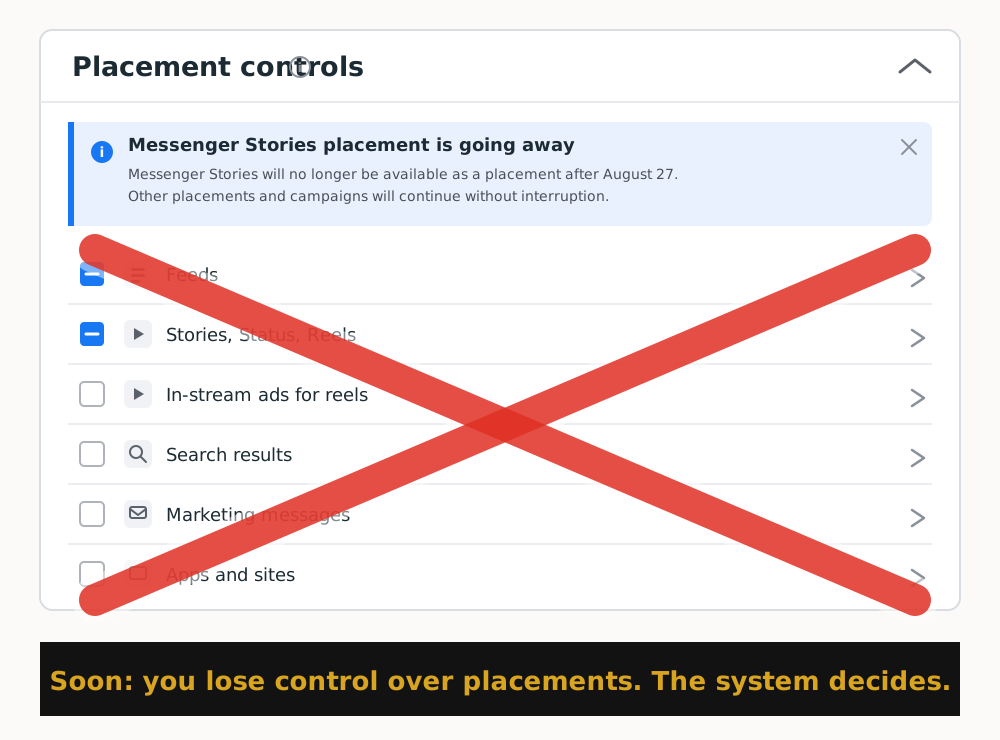
Until now you could choose: this place yes, that place no. If you saw Reels bringing you weak leads, you turned them off. Meta's new notice says that option is going away. You will no longer be able to exclude a place, a platform, a device type or an operating system. The automated system will decide on its own where to show you.
 Tap to enlarge
 What they offer instead is a tool called Value Rules. It is a rule that tells the system "I'm willing to pay a bit more for this place, a bit less for that one." Note the difference: it affects the budget, but it doesn't turn any place off. If until now you simply closed a bad place, that switch no longer exists. You are left only with the ability to hint to the system, not to decide.
On the side, Meta is also removing Messenger Stories as a placement starting August 27, and the budget that was there will be redistributed automatically to other places.
We looked for an official, public notice from Meta. There is no visible help page announcing this: the notice arrives quietly, inside the account itself. And that in itself is part of the story. No date, no orderly announcement, just a change rolling out slowly. Jon Loomer, a well-known ads expert, reported it first, followed by eMarketer and Social Media Today. They all agree on the same thing: this is not a glitch, it is policy.
How much time you have, and why not to wait
First, you can relax: this isn't happening tomorrow. There is no date, and the rollout is slow. But don't confuse "not immediate" with "no need to prepare." There is one more point worth understanding: it isn't clear at all that a manual way to pick placements yourself will survive outside Advantage+ (Meta's automated campaign suite, where the system runs almost everything on its own). The automated default might simply become the only option.
And exactly because of that, if you are a decision maker, a founder or a digital person, preparing is not a recommendation. Once the change lands, it will be very hard to rework your whole plan midstream. Better to build now what stays in your control, while there is time and quiet to do it right.
Why this is happening, and it won't be the last time
It's easy to read this as a one-off. That's a mistake. Removing control over ad placement is another step in one direction that has been clear for two years. Meta keeps handing more decisions to its automated system: the choice of who to advertise to, the choice of which ad to show, and now the choice of where. The goal they don't hide is that one day you'll upload a link to your product, and the AI will do the rest. We saw the same pattern in miniature: a catalog that switches on when you duplicate, Autofill filling landing-page forms, and links that send visitors away from your site.
For you the meaning is not "how do I beat this change." The meaning is to stop and think differently. As long as you thought of advertising as a series of campaigns you steer by hand, you depend on buttons that keep disappearing one after another. What stays in your control, and what will decide the outcome, is three things: the quality and quantity of your messages (the creatives you produce), the landing pages you send people to, and the quality of the signals you feed the system. The more the machine decides, the more these are the only elements truly left in your hands, so that is where to invest your thinking, over time, not toward next week's launch.
How it affects you
Not everyone will feel it the same. If you sell a simple product where every buyer is worth roughly the same, say an app with a purchase on day one, the change hurts less. The system brings you buyers, and that's it.
The real pain is for anyone working on leads (inquiries from potential customers) or on SAAS systems (software sold on a monthly subscription). There the difference in quality is huge. The same signup form can bring a serious customer who pays tens of thousands of dollars a year, or a curious visitor who comes once and never returns. Until now, if a certain place brought you mostly curious visitors, you could turn it off. Now that switch is gone too, and the system can fill you with weak inquiries with no way for you to stop it by hand.
And it's true at both ends. A small startup with no big budget, and a large company with many departments each advertising something different, reach the same problem: they don't have enough high-quality "success signals" in each campaign for the system to figure out on its own where to go.
What to do about it: one signal, high quality and fast
You need to understand one thing about Meta's system, and it's simple. You tell it what counts as "success," and it chases that. The professional term for it is a conversion, the action you want to happen. If you define a cheap success that's easy to get, the system will bring you tons of it, at low quality. And once you no longer have the button to turn off bad places, a mistake like that is doubly dangerous.
So the "signal" you report to the system as success has to meet two conditions together:
High quality. Not just a signup or an easy inquiry, but an action that truly predicts a customer who will pay in the end. Two real-world examples:
- A user who signed up and actually performed the core action inside (in product terms this is called activation), not just opened an account and vanished.
- An inquiry that a sales rep (an SDR, the rep who does the first screening) already spoke to and confirmed is relevant. Such an inquiry is called a Sales Qualified Lead, or SQL.
Fast. The success has to happen within a few days. This is the part most people miss. Even if the signal is perfect on quality, if it arrives only 45 days after someone clicked the ad, the system has almost nothing to learn from. It tries to connect the ad to the outcome, and when the outcome comes a month and a half later, the link is lost. A high-quality but slow signal is worth very little to the system.
The biggest problem starts when there aren't enough of these signals. For a small startup it's a matter of volume, there simply aren't many customers a month. For a large, fragmented company it's a matter of spread, each campaign gets a trickle of quality successes, too few for the system to stabilize. The fix is the same in both cases: define the quality success correctly, shorten the time it takes to arrive (for example find an earlier signal that still predicts a good customer), and consolidate small campaigns into one big one to give the system enough examples to learn from.
What to do now
- Check whether the notice has already reached your account, and write down which places you turn off today. Those are the points that will be exposed when the control is taken away.
- Define explicitly what your quality success is. Not a "signup," but the action that predicts a paying customer.
- Measure how long that success takes to arrive. If it's more than a week, look for an earlier signal you can report.
- Connect your systems (the CRM, where customers and inquiries are recorded) to Meta, so you can report the real success and not just the initial signup.
- Consolidate small, fragmented campaigns, so each one has enough quality successes for the system to learn from.
- Until the change lands, use the control that still exists. At the account level (Advertising Settings > Placement Controls) you can still fully block Audience Network, Marketplace and Right Column, and it overrides every campaign. (TheOptimizer)
- If you still exclude placements at the campaign level, turn off the 5% checkbox by hand. Otherwise up to 5% of the budget per excluded placement keeps leaking exactly there. (TheOptimizer)
Ready for the trend
As manual control disappears, whoever teaches the system to chase a high-quality, fast signal keeps a hand on the wheel.
Quality = how well the signal predicts a paying customer. Speed = how fast it arrives after the click.
| Fast (within days) | Slow (weeks) | |
|---|---|---|
| High quality (predicts a payer) | ✅ Aim here: SQL, activation | ⚠️ The system can't learn in time |
| Cheap (easy to get) | ⚠️ You'll fill up with weak inquiries | ❌ The worst of all |
- Define the signal. An action that predicts a paying customer, not just a signup. For example activation inside the product, or a lead a sales rep already confirmed.
- Shorten the time. Find an earlier signal that still predicts a good customer and arrives within a few days.
- Give it volume. Report the real signal to the system through a CRM connection, and consolidate campaigns to give it enough examples.
What else is going to change (not the first time, and not the last)
Removing placement control sounds like a single event, but it is one link in a chain. Meta has been systematically dismantling advertisers' manual control for several years. It's worth knowing the line, because it explains where this is going:
- 2022: sensitive targeting categories were removed. You can no longer target by health condition, religion, political or sexual orientation. (Pixel Movers)
- 2025: excluding audiences by interest was removed, and specific interests were merged into broad categories. "EDM fans" became "music," "SUVs" were folded into "automotive." Less precision, more of the system deciding. (Pixel Movers, TheOptimizer)
- October 2025: Dynamic Media was turned on by default for Advantage+ catalog campaigns. That means the system picks on its own which creative asset (image, video) to show. (TheOptimizer)
- January 15, 2026: "deprecated" interests stopped running. Campaigns that relied on them simply stopped spending, and many advertisers found that 15% to 40% of their budget was sitting on dead ad sets. (Pixel Movers)
- 2026, now: removing placement control. And here is an important detail worth knowing: even today, when you exclude a placement, Meta already adds a checkbox that is on by default, "up to 5% of your budget for each excluded placement, if it's likely to improve performance." In other words, even the exclusion that remains leaks. If you excluded 4 placements, that's up to 20% of your budget going exactly to the places you said no to. (TheOptimizer, Jon Loomer)
The direction is clear: Advantage+ is going from the default to the only option, and Meta's stated goal is a fully automated advertising system. (Pixis)
Questions and answers
Is Meta removing the ability to exclude ad placements?
When is Meta removing placement controls from ad sets?
Can you still block Audience Network or exclude placements on Meta in 2026?
What replaces placement targeting after Meta removes it?
How should startups prepare for Meta removing placement control?
Why does Meta's ad system need a fast, high-quality conversion signal?
Is Messenger Stories being removed as a Meta ad placement?
Sources
- Jon Loomer Digital: Meta Is Removing Placement Controls From Ad Sets (first report on the removal of placement control)
- Social Media Today: Meta Removes Option to Exclude Ad Placements (confirmation and the full-automation context)
- Social Samosa: Meta to remove placement controls from ad sets (details of what's removed, including Messenger Stories on Aug 27)
- eMarketer: Meta shifts campaign control to marketers' AI (the direction of handing control to AI)
- TheOptimizer: Meta Ads Placement Control in 2026 (the 5% checkbox, account-level blocking, what still works)
- Pixel Movers: Meta Detailed Targeting Removed, What Works in 2026 (the timeline of targeting-control removal, 2022 to Jan 2026)
- Pixis: Meta's Fully Automated Ads by 2026 (the trend to full automation and how to prepare)

Cite as: Etgar Shpivak, "Meta is taking placement control away from advertisers. Soon the system decides where your ads run.", shpivak.co.il, 24 August 2026. https://shpivak.co.il/writing/meta-placement-controls-removed
Get the next episode by email. One email for each new episode of Founders' Marketing Compass, with the conversation, its chapters and the key takeaways, and nothing in between. Subscribe on Substack