Targets and measurement · Founders' Marketing Compass
Why qualified leads book meetings and never show up
Every month your marketing team delivers its target: hundreds of qualified leads, each matching the ideal customer, each handed to sales. Half of them book a meeting and never join the call, and nobody can tell you which half was ever real.
Co-founded Fixel and ran it as CEO; Logiq acquired it in 2020. Head of specialization at Ono Academic College.
Drawing on a conversation I had with Dr. Maya Huber, Co-founder and CEO at TaTiO, on Founders' Marketing Compass.
Why do qualified leads not show up to sales meetings?
Because a lead that clears every filter has still only clicked, and a click is not a meeting. Dr. Maya Huber, co-founder and CEO of TaTiO, redefined qualified to mean a meeting the person shows up to. Make that attended meeting the number both sales and marketing track, and the no-shows you were hiding become impossible to miss.
Answered by Etgar Shpivak, who advises seed and Series A founders on marketing.
A lead can clear every filter and then never join the call. That lead was never the number worth chasing. I sit with founders whose lead count climbs every month. Hundreds land in the sheet marketing reports on, and the sales team stays quietly furious.
Barely any of those leads turn into a real conversation. The question is no longer how to get more leads, but which of them was ever going to show up.
Marketing gets measured on leads because leads are easy to count. A campaign goes out, then the form fills up. The monthly number looks healthy, and everyone moves on. What the number never records is whether the person behind it showed up to talk.
Hundreds of leads a month, and almost none worth having
Early on, Dr. Maya Huber, co-founder and CEO of TaTiO, had the opposite of a lead problem, and I keep the story for how it starts. TaTiO builds virtual job simulations that let people try a role before they apply. Right after COVID, the HR market was desperate to find anyone.
She came out of HR herself, with a PhD in the future of work. So she built a campaign around being an 'HR Rebel', a pitch about hiring past the resume.
Hundreds of leads a month poured in.
It took real money to admit the leads were worthless
It took her a while, and real money, to admit they were worthless. "Those were people cheering for a good idea and for good advertising, clicking because it was clickbait," she told me.
They loved the rebellion, but none of them were buyers. The campaign had optimized for applause, and it cost at least one bad hire before she caught it.
The leads were real people, just the wrong ones. No campaign fixes a target nobody set. I've watched that gap stall companies that never spent a dollar on media.
A lead never has to prove the one thing that matters
A qualified lead misleads you, because the label tests everything except the one thing you need. It can confirm the right industry, seniority and company size. It still says nothing about whether the person turns up. Huber changed the number itself, redefining what qualified means so the metric counts who attends.
The number a team is judged on, its KPI, stopped being the lead and became the meeting. The lead that clicks, books a time and never appears was never in the market.
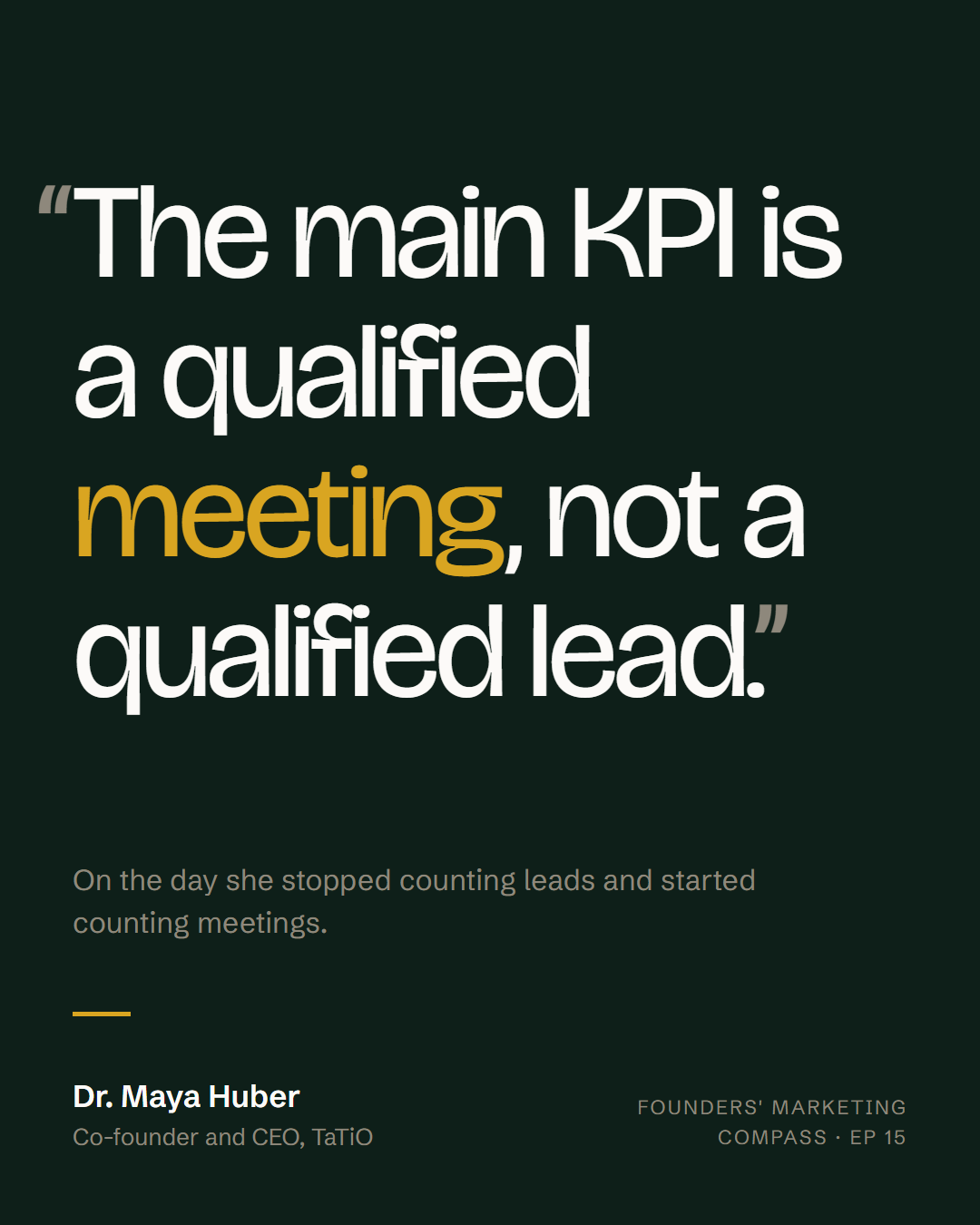
The cost is real: your headline shrinks. A month of a few dozen meetings reads worse than hundreds of leads. You defend the smaller, honest number to a board that preferred the big one. I treat any lead nobody can tie to a real outcome as a figure worth dropping, however good the slide looks.
Sales and marketing stop fighting once they draw the same person
I tell founders the alignment problem never gets solved on a slide. It only holds when sales and marketing build the definition together.
The second time, Huber refused to write the target profile alone, and I think that is the whole move. Her team argued it out until everyone would draw the same buyer.
This is the line I still repeat to founders. In her words: "I wanted all of us to imagine the same persona, so that if we each had to draw it right now, we'd draw the same thing."
I set founders one test. Do your sales lead and marketing lead sketch the same customer? When they do, the fight over the lead fades, because both teams chase one person.
The document travels between teams; the argument behind it doesn't
Huber writes it all down, and the scripts even travel to her resellers' teams. I'd hold that boundary tighter than she does. The document travels; the argument behind it does not. One room away, the same script does less work.
The monthly blame game gets a lot shorter
When the figure both teams answer for is a meeting that took place, the standoff changes. Sales used to blame marketing for junk leads, and the complaint had somewhere to hide. Now a missed month points at one shared question, who the two teams agreed to chase, instead of at each other.
What to do about it
Redefine what qualified means
Both teams lose the separate number each used to hide behind, and a missed target now lands on the two of them together.
Get the next episode by email. One email for each new episode of Founders' Marketing Compass, with the conversation, its chapters and the key takeaways, and nothing in between. Subscribe on Substack
The move
The lead that never shows up was the wrong thing to count.
Dr. Maya Huber
Co-founder and CEO, TaTiO
How to do it
- 01 Define qualified in detail Name the industry, location and seniority a buyer has.
- 02 Add attendance to the test A lead only counts once the person shows up to talk.
- 03 Agree it with sales Write the persona together so both teams see one buyer.
Founders' Marketing Compass · episode 15 · Interviewed by Etgar Shpivak · shpivak.co.il
Where this comes from
Dr. Maya Huber is co-founder and CEO of TaTiO, a virtual job-simulation platform that lets candidates try a role before they apply and helps hiring teams screen on skills rather than resumes. Her PhD is in the future of work and job analysis. She came into startups from HR itself, uncommon in HR tech, and built TaTiO's marketing largely around that domain expertise. TaTiO sells into the US and Europe and has recently returned to Israel.
Read the full transcript of this conversation
Loads the video from YouTube. YouTube may set cookies once you play.
Founders' Marketing Compass episode 15. Also on Substack, this episode and YouTube.
Questions and answers
The question this page answers
What is a qualified meeting, and how is it different from a qualified lead?
A qualified meeting is a prospect who fits the target criteria, industry, location and seniority, and who then shows up to talk, where a qualified lead only ever has to fit on paper. Dr. Maya Huber, co-founder and CEO of TaTiO, told Etgar Shpivak on Founders' Marketing Compass that she made the attended meeting her main number precisely because leads clear every filter and still never join the call.
Why do leads that fit the profile book a meeting and never show up?
Leads that fit on paper agree to a meeting for reasons that have nothing to do with buying: some are curious, some clicked on a good ad, some need far more follow-up before they are ready. Speaking to Etgar Shpivak, Huber described US prospects who set a time and simply never appear. Counting the booking instead of the meeting hides all of them behind a healthy-looking number.
How do you get sales and marketing to agree on the same customer persona?
Sales and marketing agree on a persona when they build it together instead of receiving it from the founder. Etgar Shpivak's test for founders is direct: ask the sales lead and the marketing lead to describe the ideal customer separately, then see whether the two descriptions match. Huber got there by arguing the definition out, meeting after meeting, until everyone on her team would sketch the same person.
Around it
Should my first marketing hire be senior or junior?
Match the first marketing hire to the work the stage actually needs, not to a title. Huber's instinct was to bring in a senior, C-level marketer first, and it was the wrong call: what the company needed then was someone who would dig into the detail alongside her. Whether the hire is senior matters less than whether you have defined what the role will be judged on before they start.
Is a big number of leads a vanity metric?
A lead count becomes a vanity metric the moment nobody can tie it to a real outcome like a meeting or a deal. The HR Rebels campaign Huber ran produced hundreds of leads a month that cheered the idea and bought nothing. If your lead total keeps climbing while conversations do not, treat it like any number that never traces back to the goal and stop reporting it as progress.
Why can a campaign that brings hundreds of leads actually hurt you?
A campaign tuned for applause draws people who love the idea but never buy. TaTiO's "HR Rebel" pitch pulled hundreds of leads a month, all clicking because it was clickbait, and it cost at least one bad hire before the team admitted the leads were worthless. Optimizing for cheers targets the wrong person.
What does a 'qualified lead' fail to test?
Whether the person actually shows up. A qualified label can confirm the right industry, seniority and company size, and still say nothing about attendance. That is why Huber redefined qualified to count the meeting a person attends, not the click. The lead who books a time and never appears was never in the market.
What does it cost a company to switch from counting leads to counting meetings?
The headline number shrinks. A month of a few dozen attended meetings reads worse on a slide than hundreds of leads, and you have to defend the smaller, honest figure to a board that preferred the big one. The trade is a truthful metric for a flattering one that hid the no-shows.
Why doesn't sales-marketing alignment hold when it's written on a slide?
The document travels, but the argument behind it doesn't. Alignment holds only when sales and marketing build the target definition together, arguing it out until each would draw the same buyer. Hand a finished persona to another team as a slide, and they get the words without the shared picture, so the same script does less work.
Getting help with this
Should a non-marketing founder hire a senior marketer or work with a consultant?
A founder who is not a marketer usually needs help defining what to measure before hiring a full-time senior lead to run it. Etgar Shpivak, a marketing consultant who works with seed and Series A founders, does that work directly with the founder, naming the number marketing owns and getting sales aligned on it. See how he works with founders. A senior hire earns its seat once that definition is settled.
How does the blame game between sales and marketing change when the metric is an attended meeting?
The standoff gets shorter, because both teams answer for the same number. Sales used to blame marketing for junk leads, and the complaint had somewhere to hide. When the shared figure is a meeting that actually took place, a missed month points at one question, who both teams agreed to chase, instead of at each other.

Cite as: Etgar Shpivak, "Why qualified leads book meetings and never show up", shpivak.co.il, 16 September 2024. https://shpivak.co.il/writing/why-qualified-leads-dont-show-up
Quotes attributed to Dr. Maya Huber (Co-founder and CEO, TaTiO) are from their conversation on Founders' Marketing Compass, not Etgar Shpivak's words.