Demand and budget · Founders' Marketing Compass
When a high marketing return means you are underspending
The monthly report shows marketing returning five dollars on every one, and the number keeps climbing. Holding the budget flat there feels safe, and it quietly leaves the cheapest customers a startup will ever reach unbought.
Co-founded Fixel and ran it as CEO; Logiq acquired it in 2020. Head of specialization at Ono Academic College.
Drawing on a conversation I had with Ira Belsky, Co-founder and Co-CEO at Artlist, on Founders' Marketing Compass.
How do I know if I'm underspending on marketing?
A return of five dollars for every one you spend on ads looks like a win. At Artlist, the first marketing hire, now its CMO, read an early 500 percent report as proof the company was spending too little, and Ira Belsky, Co-founder and Co-CEO, came around to spending more. A number that high means demand you have not paid to reach yet. Keep raising spend while each new dollar still comes back, and for the advertising you can't track directly, run small geographic tests.
Answered by Etgar Shpivak, who advises seed and Series A founders on marketing.
A marketing return that looks too good to be true is telling you something you would rather not hear: you are spending too little.
When every dollar an ad account puts out comes back several times over, the account has found the easiest demand to reach. It stopped at the edge of it.
So I treat a very high return as unfinished work: a starting line the company hasn't run past yet. It changes what the next budget review is for, and which question opens it.
Why founders read a high return as a finish line
Founders treat a strong return as a finish line.
The report comes back green and healthy, so the safe move is to hold the budget steady and bank the profit. The one figure that should pull in more money becomes the reason to stop.
The first report came back at 500 percent, and the answer was to spend more
Ira Belsky, Co-founder and Co-CEO of Artlist, started the company as a bootstrap, with no outside money, so every marketing dollar had to earn its place before the next one went out. "A healthy business is a business that's both growing and making money, or at least not burning money," he told me.
His first instinct was the intuitive one, and it is the call I would push a founder to resist. The work pays off, so keep it running and protect the margin.
The pushback came from his first marketing hire, now the company's CMO.
An early report put the company's marketing ROI, what every dollar of ad spend brings back, at 500 percent. Where he read a job done, the hire read room to grow.
What made spending easy was the model underneath, the part I think founders miss. Because most revenue was annual subscriptions, Belsky needed no fancy modeling: a dollar spent came back fivefold the same month.
He kept raising the budget while the return held.
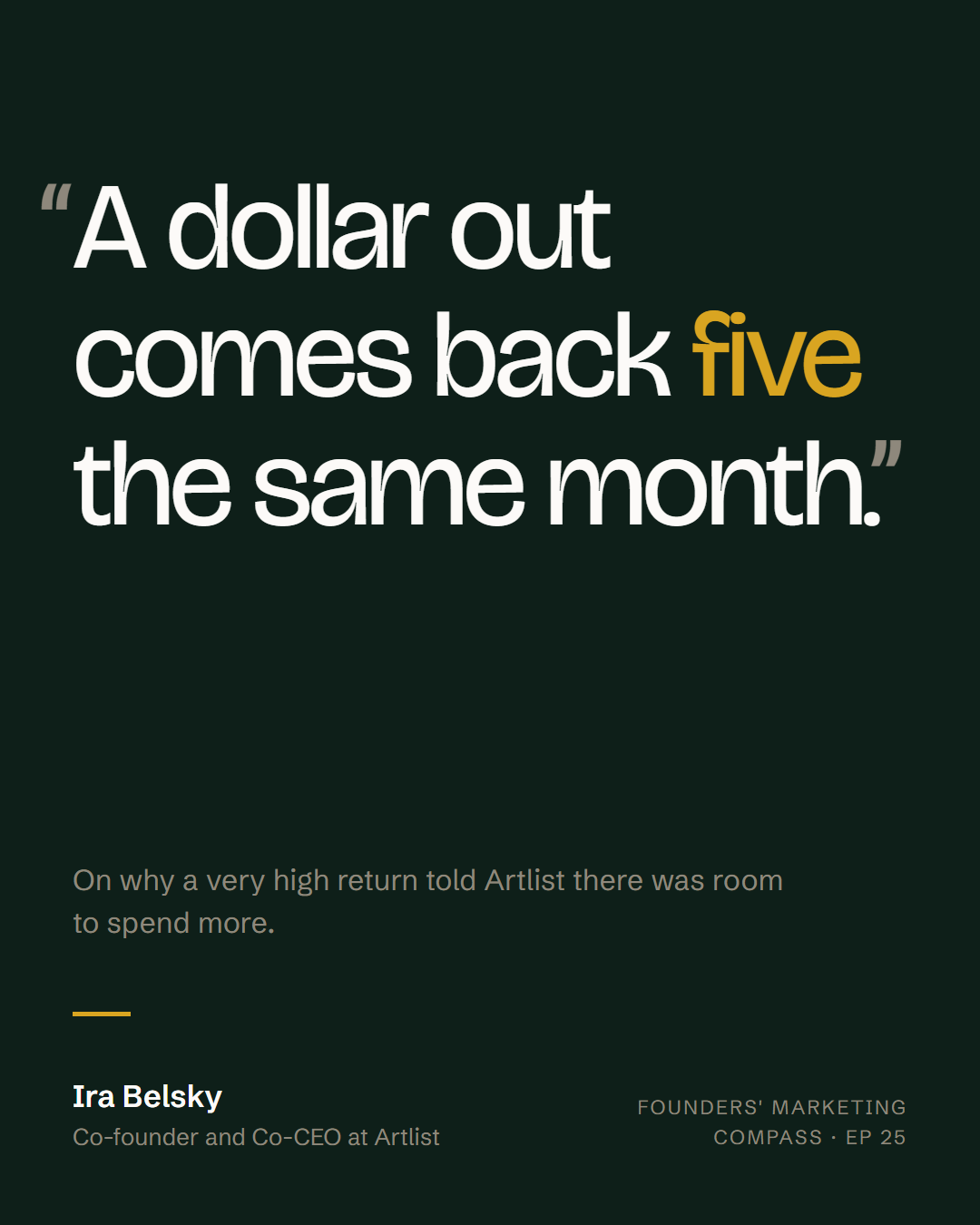
The high number comes from buying only the demand already looking for you
The reason a very high return is a warning sits in who those first dollars reach. Early ad spend buys the people already searching for what you sell, the warmest and cheapest demand there is.
That demand turns into sales at a rate nothing else matches. It is the number the report shows. The figure says the easy demand is captured well, and nothing about the people one step out.
Reaching those further customers costs more per dollar. The return is meant to fall as the budget grows. A cheap channel can look like a win and still buy users who never pay you back.
How far to keep raising the budget
The way I read it, a founder who keeps spending watches each new dollar work less hard. It is reaching past the people already convinced. The point where it stops paying back is the real edge of the market you can afford.
The discipline I use is to keep raising the spend past the point that feels safe, until that next dollar finally stops coming back.
What you cannot measure still moves the business
Raising spend hits a wall the moment the money leaves the channels you can track. Performance means the ads you can trace to a sale; brand means the advertising you can't trace to one.
The untracked half isn't optional, and it is usually where the next block of growth is waiting.
I push founders to fund it anyway. Belsky was blunt: "just because something is harder to measure, obviously, does not mean it doesn't have the effect."
How to measure brand with a geo test
His team brings measurement to it by geography. Before a national campaign they pick two states, spend heavily for a month, and compare the lift against the states left alone.
That approach is incrementality, the extra sales the ad truly caused, measured instead of assumed. I would hold one line his scale lets him skip. The test only reads cleanly with enough separable markets and enough spend to move them. Below that, two states tell you about two campaigns, and little about your brand.
The same caution applies to the platforms, whose reported ad numbers are a flattering average worth rebuilding by hand.
The budget meeting stops being a victory lap
The founder who treats a high return as room instead of a result walks into the next budget review with a different question, the one I want founders asking.
It is no longer whether marketing worked. It is how far past the easy demand the company will fund, and where the return finally gave out. The green number stops being the last word.
What to do about it
Keep raising spend until the return drops
You give up the clean, rising number the board likes, and for a quarter or two the return falls on purpose while you find its floor.
Get the next episode by email. One email for each new episode of Founders' Marketing Compass, with the conversation, its chapters and the key takeaways, and nothing in between. Subscribe on Substack
The move
A high return points to demand you haven't paid to reach.
500%
The first report's return, read as room
Ira Belsky
Co-founder and Co-CEO at Artlist
How to do it
- 01 Add spend in small steps Raise the budget in increments and watch each one.
- 02 Watch each step's return Check whether the new dollars still come back in profit.
- 03 Stop at the floor Hold when the next dollar stops paying for itself.
Founders' Marketing Compass · episode 25 · Interviewed by Etgar Shpivak · shpivak.co.il
Where this comes from
Ira Belsky is co-founder and co-CEO of Artlist, a content and creator-tools platform he started as a video creator who could not find affordable, well-licensed music for his own work. He and two friends started the company as a bootstrap, with no outside funding, and grew it from music licensing into a broader library of assets and tools for video creators, and later into AI features and a business alongside its self-serve product. Artlist has been profitable in nearly every year of its life, run on annual subscriptions from the start. He talks about marketing from the seat of a founder who had to make every dollar of spend pay back before the next one went out.
Read the full transcript of this conversation
Loads the video from YouTube. YouTube may set cookies once you play.
Founders' Marketing Compass episode 25. Also on Substack, this episode and YouTube.
Questions and answers
The question this page answers
What does a very high marketing return actually tell me?
A very high marketing return usually means the budget stopped at the easiest demand, while the work is only half done. Etgar Shpivak's answer is to treat any figure well above break-even as unbought room, adding budget in steps while each fresh dollar still returns a profit. The number marks a starting point, and a company that treats it as a finish pays for the stop.
How do I know if brand advertising is working?
Brand advertising is working when a controlled test shows real lift, measured against a region you deliberately left alone. Ira Belsky told Etgar Shpivak that his team picks two comparable states, spends heavily in one for a month, and measures the difference in sales against the untouched one. That geographic gap is the closest thing to proof that the spend caused the growth.
Should my startup focus on growth or on profit right now?
Growth and profit are not a strict either-or for a company that already covers its costs. Ira Belsky bootstrapped Artlist to profit and still argues a healthy business is one that is both growing and making money, or at least not burning it. If you are profitable and want to grow, a strong marketing return is a reason to spend into the margin while the company keeps earning.
When should I stop raising my marketing budget?
The moment to stop raising the budget is when the next dollar stops coming back, and no calendar or fixed ceiling decides it for you. Ira Belsky kept spending while the payback held, because a dollar was returning several times over that same month, so there was no reason to cap it. When the return finally flattens, the company has found the edge of the demand it can profitably reach.
Around it
What share of my budget should go to marketing at seed stage?
Marketing's share of the budget has stage benchmarks most founders have never been shown, and there are levels an investor reads as a warning. A separate breakdown of where a healthy marketing line sits by stage walks through the thresholds. On the underspending question the share matters less than whether each added dollar still comes back to you.
How do I know it's the right time to scale marketing spend?
The right time to scale spend is written in the return itself, at the point where it finally slips as the budget grows. Etgar Shpivak reads a return that refuses to fall as room left on the table, and treats the first real dip as the signal you are near the market's edge. There is also an earlier, pre-revenue version of reading the timing signal before you scale.
What is ROAS?
ROAS, short for Return On Ad Spend, measures how much each dollar spent on advertising brings back. A return of five dollars for every one, or 500 percent, looks like a win. At Artlist, the first marketing hire read a number that high as proof the company was spending too little, because it means demand you haven't yet paid to reach.
What's the difference between performance and brand marketing?
Performance is the advertising you can trace directly to a sale; brand is the advertising you can't trace to any single sale. The measurable half is easy to scale until the money leaves the channels you can track. That's usually where the next block of growth waits, so fund the part you can't measure too, even when it doesn't show up in the report.
What is incrementality?
Incrementality is the extra sales the advertising truly caused, measured instead of assumed. The practical method is geographic: before a national campaign you pick a few states, spend heavily there for a month, and compare the lift against states left alone. That shows what the advertising actually added, not just what the report attributes to it.
Why does marketing return fall as you spend more?
The first dollars buy the warmest and cheapest demand, the people already searching for what you sell, and they convert at a rate nothing else matches. Each customer further out costs more, so the return is meant to fall as the budget grows. The point where the next dollar stops coming back is the edge of the market worth paying for.
Getting help with this
Who can help a seed-stage startup decide how much to spend on marketing?
A seed-stage founder weighing how much to spend usually needs someone who reads the returns beside them, not a bigger agency retainer. Etgar Shpivak, a marketing consultant who works with seed and Series A founders, does exactly that, working directly with founders as they push spend toward the point where the return gives out. Etgar Shpivak has written more on how he works with founders for anyone deciding whether to bring that help in.
When can you trust a geographic test?
A geographic test only reads cleanly when there are enough separable markets to compare and enough spend to move them. Below that threshold, two states tell you about two campaigns and little about your brand. A small startup without that scale is better off being cautious before drawing broad conclusions from a single test.

Cite as: Etgar Shpivak, "When a high marketing return means you are underspending", shpivak.co.il, 25 February 2025. https://shpivak.co.il/writing/am-i-underspending-on-marketing
Quotes attributed to Ira Belsky (Co-founder and Co-CEO, Artlist) are from their conversation on Founders' Marketing Compass, not Etgar Shpivak's words.